History & SymbolsEuropean Winter Folklore
Acebo (Holly)
Spiky winter evergreen — often confused with mistletoe
Holly (Ilex aquifolium) is a glossy, spiny evergreen shrub with bright red winter berries long used to decorate doors, hearths, and wreaths across Europe and the Americas. While European folklore often credited holly with good luck and winter protection, the English custom of kissing beneath a hanging sprig belongs to white-berried mistletoe (Viscum album, or muérdago), not prickly holly.
Music & Carolsc. 1743–1751
Adeste Fideles (O Come, All Ye Faithful)
Eighteenth-century Latin Christmas hymn
Known in English as “O Come, All Ye Faithful” and in Spanish as “Venid, fieles todos,” Adeste Fideles is one of the world’s best-known Christmas hymns. First published in mid-eighteenth-century manuscripts copied by English Catholic music scribe John Francis Wade (c. 1743–1751), the Latin carol invites the faithful to Bethlehem and was later translated by Frederick Oakeley in 1841.
Traditions & Rituals19th c.–present
Advent Calendar (Calendario de Adviento)
Counting down the 24 days to Christmas Eve
Originating in nineteenth-century German Protestant households—who marked chalk tallies on doors, lit numbered Advent candles, or hung 24 small pictures—the printed Advent calendar with opening doors was pioneered in Munich by Gerhard Lang in the early 1900s. Today families enjoy paper, wooden, chocolate, and digital editions counting from December 1 to 24.
Traditions & Rituals1839–present
Advent Season & Advent Wreath
Four Sundays of evergreen light preparing for Christmas
Advent spans the four Sundays before Christmas as a season of quiet reflection and anticipation. The modern evergreen Advent wreath with candles was popularized in nineteenth-century Hamburg by Lutheran pastor Johann Hinrich Wichern; in Catholic churches and homes, four candles—typically three violet and one rose for Gaudete Sunday—often surround a central white Christ candle lit on Christmas Eve.
Traditions & RitualsLatin America & Caribbean
Aguinaldos
Treat bags, holiday bonuses, and Dominican door-to-door caroling
Across the Spanish-speaking world, aguinaldo carries three festive meanings: small bags of seasonal sweets, peanuts, and fruit handed out at Mexican posadas; year-end holiday bonuses; and joyful door-to-door caroling groups in the Dominican Republic, Puerto Rico, and Venezuela accompanied by tambora, güira, cuatro, and accordion in exchange for ginger tea, coffee, or sweets.
Traditions & Rituals19th c.–present / Ecuador
Años Viejos & Doll Contests (Ecuador)
Monumental papier-mâché effigies lighting up December 31
Across Ecuador—especially in Guayaquil and Quito—families, neighborhoods, and workplaces build intricate life-size or monumental papier-mâché effigies (monigotes or años viejos) depicting the year’s headlines, characters, and satire. Judged in festive New Year’s Eve competitions before midnight, the effigies are burned to turn the page toward a fresh year.
Traditions & RitualsAlgeciras, Spain
Arrastre de Latas (Algeciras)
Clattering tin-can parades calling the Three Kings on January 5
Every morning of January 5 in Algeciras (Cádiz, Spain), thousands of children string empty tin cans into long chains and sculptures, dragging them loudly through the streets to the port. Local legend says the clatter scares away the grumpy Giant of Botafuegos, whose smoke clouds would otherwise hide the town’s rooftops from the arriving Three Kings.
Texts & BeliefsLate 12th century
Auto de los Reyes Magos
Oldest surviving dramatic text in Castilian Spanish
Preserved in a fragmentary 147-line manuscript from Toledo dating to the late twelfth century (kept at Spain’s National Library), the anonymous Auto de los Reyes Magos is the earliest surviving theatrical play written in Castilian Spanish. In five lively scenes, Gaspar, Melchior, and Balthazar marvel at the star, debate its meaning, and confront an anxious King Herod.
History & Symbols16th century–present
Brindis (Holiday Toast)
From German “ich bring dir’s” to five-sense clinking
The Spanish word brindis (“toast”) entered via sixteenth-century Italian from the German military and drinking salutation “ich bring dir’s” (“I bring it to you” / “I offer this to you”). Holiday toasts celebrate friendship and goodwill—playfully engaging sight, smell, taste, touch, and hearing when glasses clink together.
Food & Drinks14th c.–present
Budín y Christmas Pudding
From medieval frumenty and plum pottage to festive loaves
While popular lore sometimes compares rich winter puddings to the Celtic god Dagda’s cauldron, culinary historians trace British Christmas pudding directly to medieval cracked-wheat frumenty and savory-sweet plum pottage (“plums” meaning dried raisins). In Argentina and the Southern Cone, budín also refers to loaf-shaped sponge cakes studded with candied fruit, nuts, or chocolate.
Food & DrinksAncient–Medieval
Candied Fruit (Frutas Abrillantadas / Escarchadas)
Ancient osmotic preservation turned festive jewel garnish
Contrary to a persistent myth that sugar glazes were invented to disguise spoiled fruit, candying originated in ancient Mesopotamia and China using honey and was refined by medieval Arab confectioners using cane-sugar syrups to preserve fresh fruit through winter. Today colorful candied citrus and cherries crown Spanish Roscón de Reyes and Milanese panettone.
Food & DrinksAndean Ecuador
Canelazo Quiteño
Warm Andean cinnamon and naranjilla drink
A beloved cold-evening drink across Ecuador’s Andes—especially during Quito’s December festivals and Christmas gatherings—canelazo simmers water with cinnamon sticks, cloves, panela (unrefined cane sugar), and tart naranjilla juice, served piping hot with an optional splash of aguardiente.
Music & CarolsMexico
Canto de Piñata («Dale, dale, dale»)
Traditional Mexican posada rhyme
While blindfolded children take turns swinging at the star-shaped piñata during Mexican posadas, guests sing the traditional verses “Dale, dale, dale, no pierdas el tino…” (“Hit it, hit it, hit it, don’t lose your aim…”), cheerfully warning the swinger to measure the distance before sweets, peanuts, oranges, and tejocotes rain down.
Characters & Figures16th century–present
Christkind (Christkinder)
Reformation-era angelic gift-bringer across Central Europe
Introduced in sixteenth-century German Protestant communities as an alternative to St. Nicholas’s December 6 feast, the Christkind (“Christ Child”) evolved into an angelic white-and-gold figure who brings presents on Christmas Eve. Today the Christkind remains deeply loved in southern Germany, Austria, Switzerland, and parts of Central Europe.
History & Symbols4th century–present
Christmas (Navidad): Origins & Global Dates
From Latin Nativitas and the 354 CE calendar to Fort La Navidad (1492)
Spanish Navidad derives from Latin Nativitas (“birth”), while English Christmas comes from Old English Crīstesmæsse (“Christ’s Mass”). First documented on December 25 in Rome’s Chronograph of 354 CE (and championed in the East by John Chrysostom in 386 CE), the feast reached the Americas on December 25, 1492, when Columbus’s crew built Fort La Navidad on northern Hispaniola from the wrecked Santa María.
History & SymbolsGlobal Tradition
Christmas Candles & Light (Velas)
From Nordic hand-dipped candles and Colombia’s Velitas to Advent light
Candles symbolize hope and light at the winter solstice across Christian and cultural traditions—from hand-dipped Nordic Christmas candles and Advent wreaths to Colombia’s December 7 Día de las Velitas and Mexican posada tapers. (Liturgically, the tall Paschal candle belongs specifically to Easter Vigil rather than Christmas.)
History & Symbols1843–present
Christmas Cards (Tarjetas de Navidad)
Born in London in 1843 alongside Britain’s Penny Post
The first commercial Christmas card was created in London in 1843 (not 1846) when Sir Henry Cole commissioned artist John Callcott Horsley to print 1,000 hand-colored greetings. Later in the 1860s–1880s, illustrator Thomas Nast and chromolithography printers popularized illustrated holiday cards across Europe and the Americas.
History & SymbolsDecember 24, 1968
Christmas on Apollo 8 (1968)
Earthrise and a historic Christmas Eve broadcast from lunar orbit
On December 24, 1968, NASA astronauts Frank Borman, Jim Lovell, and William Anders became the first humans to orbit the Moon aboard Apollo 8. After Anders photographed the iconic color Earthrise, the crew closed a live television broadcast to hundreds of millions on Earth by reading Genesis 1:1–10 and wishing everyone a Merry Christmas.
Music & CarolsArgentina & Latin America
Christmas Serenades (Serenata)
Guitar and accordion visits beneath neighborhood windows
In twentieth-century Argentine towns and Latin American neighborhoods, groups of friends carrying guitars and accordions strolled through quiet streets in the early hours of Christmas, New Year’s, and Epiphany to sing dedicated serenades beneath friends’ windows—welcomed inside with cider, turrón, and pan dulce.
History & Symbols1605–present
Christmas Tree (Árbol de Navidad)
From 1605 Strasbourg parlors to global living rooms
While Baltic guilds in Tallinn (1441) and Riga (1510) raised winter evergreens in public squares, the earliest clear record of an indoor decorated Christmas tree comes from Strasbourg in 1605. Popularized in Britain by Queen Victoria and Prince Albert in the 1840s, the custom spread worldwide; in Argentina and several Catholic countries, families traditionally set up the tree on December 8 (Immaculate Conception).
Food & DrinksEarly 20th c. / Chile
Cola de Mono
Chile’s chilled spiced milk, coffee, and pisco punch
Enjoyed chilled during Chile’s warm December summer evenings, cola de mono (“monkey’s tail”) blends milk, brewed coffee, sugar, cinnamon, cloves, and aguardiente or pisco. Popular folklore links its playful name to early twentieth-century political anecdotes or to the dark, curled shape of an Anís del Mono bottle.
History & Symbols1164 / 1248
Cologne Cathedral & Shrine of the Three Kings
Gothic landmark built to shelter the 1164 Magi relics
On July 23, 1164, Archbishop Rainald of Dassel brought relics traditionally attributed to the Three Kings from Milan to Cologne as a gift from Emperor Frederick Barbarossa. Master goldsmith Nicholas of Verdun crafted the gilded shrine (c. 1180–1225), and Cologne’s monumental Gothic cathedral was begun in 1248—not under Charlemagne—to welcome medieval pilgrims.
Food & DrinksPuerto Rico
Coquito
Puerto Rico’s creamy coconut, cinnamon, and rum holiday toast
Puerto Rico’s signature holiday drink, coquito (“little coconut”), whips together coconut cream, coconut milk, condensed and evaporated milk, cinnamon, nutmeg, vanilla, and Puerto Rican rum (or alcohol-free versions for children). Chilled in glass bottles, it is poured for parranda carolers and gifted throughout Las Navidades.
Traditions & Rituals4th century–present
Epiphany (Epifanía)
January 6 feast of the Magi’s manifestation
Observed on January 6 in Western Christianity (and celebrating Christ’s Baptism in several Eastern traditions), Epiphany—from Greek epiphaneia, “manifestation”—commemorates the revelation of Christ to the Gentiles through the visit of the Magi. Across Spain and Latin America it marks Día de Reyes, complete with parades, Roscón de Reyes, and children’s gifts.
History & SymbolsParaguay
Flor de Cocotero (Paraguay)
Sweet-scented mbocayá palm blossom adorning Paraguayan pesebres
In Paraguay, households traditionally adorn and perfume the family nativity scene (pesebre) with the golden, intensely fragrant blossom of the native mbocayá coconut palm (Acrocomia aculeata), paired with summer fruits like pineapple, watermelon, and melon beneath rustic thatched roofs.
Music & CarolsZulia, Venezuela
Gaitas (Gaita Zuliana)
Venezuela’s exuberant December percussion and choral genre
Born in western Venezuela’s Zulia state, the gaita zuliana—driven by furro friction drum, tambora, cuatro, and charrasca—is the unmistakable soundtrack of Venezuelan Christmas, welcoming dawn serenades (amanecer gaitero), hallaca prep, and neighborhood festivities.
Music & Carols6th–10th century
Gregorian Chant (Canto Gregoriano)
Unaccompanied Latin liturgical chant across eight church modes
Named after Pope Gregory I (reigned 590–604), Gregorian chant is the central unaccompanied, monophonic Latin sacred song of the Western Roman liturgy—heard memorably in Christmas Midnight Mass propers such as Puer natus est nobis. Rather than using only five notes, it spans full diatonic scales organized into eight traditional ecclesiastical modes.
Food & DrinksVenezuela
Hallaca
Venezuela’s plantain-leaf-wrapped Christmas centerpiece
Prepared by multi-generational family teams each December, Venezuela’s hallaca wraps annatto-tinted cornmeal masa around a rich stew of beef, pork, and chicken garnished with olives, capers, raisins, bell peppers, and almonds—folded carefully inside smoky plantain leaves, tied, and boiled.
Traditions & RitualsModern Global Custom
Holiday Fireworks (Fuegos Artificiales)
Midnight skies on December 24 and 31 — and modern safety shifts
Fireworks light up midnight skies across Latin America, Australia, Europe, and Asia on Christmas Eve and New Year’s Eve. Because traditional consumer pyrotechnics carry burn and noise risks for children, wildlife, and pets, many municipalities now pair public displays with regulated, quiet-sky, or drone light shows.
History & Symbols19th c.–present
Holiday Ornaments & Colors
Red, green, gold, white, and seasonal decor
Traditional Christmas decorations—ribbons, wreaths, bells, angels, glass baubles, and string lights—cluster around evergreen green (winter endurance), crimson red (holly berries and warmth), gold (light and the Magi’s gifts), and white (snow and purity). Modern indoor decorating blossomed in the nineteenth century with German blown-glass ornaments and electric parlor lights.
Food & Drinks16th century
Holiday Turkey (Pavo / Guajolote)
Mesoamerican huexolotl carried from Mexico to European tables
Domesticated in Mesoamerica more than 2,000 years ago and called huexolotl in Nahuatl (whence Mexican Spanish guajolote), the turkey was introduced to Spain in the early sixteenth century after 1519. Modern DNA studies confirm today’s domestic turkeys descend from those ancient Mexican birds.
Traditions & RitualsDecember 28
Holy Innocents’ Day (Santos Inocentes)
December 28 pranks and satirical traditions in the Hispanic world
Observed on December 28 in solemn liturgical memory of the children of Bethlehem (Matthew 2), Día de los Santos Inocentes evolved in Spain and Latin America into a lighthearted day of harmless pranks, playful newspaper hoaxes, and friendly teasing—traditionally concluded with “¡Inocente palomita!” or “Que la inocencia te valga.”
Traditions & RitualsSan Pablo, Cusco, Peru
Inkarri, Mistirri & Negrorri (San Pablo, Peru)
Andean Three Kings horse race predicting the new year’s harvest
Each January 6 in San Pablo (Canchis province, Cusco, Peru), the Magi are reimagined as three riders—Inkarri (Inca King), Mistirri (Mestizo King), and Negrorri (Black King)—racing roughly 500 meters on horseback. Villagers read the winner as an agricultural omen: an Inkarri win foretells abundant valley crops, Mistirri favors high-altitude alpaca and llama herding, and Negrorri signals scarce harvests yet circulating trade.
Texts & Beliefs1950 / Buenos Aires
La Adoración de los Reyes Magos (Mujica Láinez)
Argentine literary story inspired by Rubens’s Prado masterpiece
In his 1950 collection Misteriosa Buenos Aires, Argentine author Manuel Mujica Láinez (1910–1984) set the tale “La Adoración de los Reyes Magos (1822)” inside a colonial Buenos Aires church, where a young deaf-mute caretaker watches a Brussels tapestry woven after Peter Paul Rubens’s 1609 painting come alive on Epiphany morning.
Characters & Figures13th c.–present
La Befana
Italy’s broom-flying Epiphany Eve gift-bringer
On the night of January 5 across Italy, folklore holds that La Befana—a soot-dusted old woman riding a broomstick—slips down chimneys to fill stockings with sweets for well-behaved children or sweet black sugar “coal” (carbone dolce) for playful mischief. Her name comes from Epifania, and legend says she forever searches for the Christ Child after missing the Magi’s caravan.
Traditions & RitualsColonial–present / Guatemala
La Quema del Diablo (Guatemala)
December 7 bonfires clearing the path for Christmas festivities
Every December 7 at 6:00 p.m. across Guatemala—on the eve of the Feast of the Immaculate Conception—families light neighborhood bonfires and set off firecrackers in La Quema del Diablo (“Burning of the Devil”), symbolically sweeping away negativity before Christmas begins. Many communities today use eco-friendly effigies to protect air quality.
Traditions & RitualsSoutheastern Mexico
La Rama (Veracruz & Yucatán)
Decorated tree-branch processions singing for holiday treats
Across Veracruz, Yucatán, and Tabasco in southeastern Mexico (often from December 16 to 24), children and neighborhood ensembles decorate a leafy tree branch with paper chains, lanterns, ribbons, and small ornaments, going house to house singing traditional verses beginning “Naranjas y limas, limas y limones…” in hopes of seasonal aguinaldo treats.
Traditions & Rituals1587–present / Mexico
Las Posadas
Nine nights of candlelit processions from December 16 to 24
Born in late sixteenth-century Mexico (authorized at San Agustín Acolman in 1587 as Missas de Aguinaldo), Las Posadas reenact Mary and Joseph’s search for lodging over nine evenings (December 16–24). Processions carry candles and sing traditional call-and-response verses (“En el nombre del cielo, os pido posada…”) before welcoming guests indoors for punch, tamales, and piñatas.
Traditions & RitualsDominican Republic & Caribbean
Lavar la Casa (Year-End House Renewal)
Dominican and Latin American New Year purification customs
In traditional Dominican households—and echoed across the Caribbean—families prepare for the New Year by scrubbing floors, airing closets, discarding worn brooms and old clothes, repainting walls, and sometimes burning incense or taking aromatic leaf baths to welcome the coming year refreshed.
Food & DrinksCaribbean & Latin America
Lechón Asado & Puerco Asado en Puya
Slow-roasted Christmas pork across the Caribbean and Latin America
Slow-roasted whole pig or seasoned pork shoulder is a centerpiece of Christmas Eve feasts across the Dominican Republic (puerco asado en puya, especially famous in the Cibao, served alongside pasteles en hoja and moro de guandules), Cuba, Puerto Rico, Colombia, and the Philippines.
Traditions & RitualsCarabobo, Venezuela
Locainas (Canoabo & Montalbán)
December 28 Holy Innocents masquerades in Carabobo, Venezuela
Every December 28—Feast of the Holy Innocents—in Canoabo, Montalbán, and neighboring western Carabobo valleys in Venezuela, colorful masked troupes called Locos y Locainas dress in patchwork ribbons and hats, dancing through streets to cuatro, maracas, and drums in satirical remembrance of King Herod’s decree.
Music & Carols1972 / 1975
Mi Burrito Sabanero
Hugo Blanco’s 1972 Venezuelan Christmas classic
Composed in 1972 by Venezuelan musician Hugo Blanco and popularized worldwide in a 1975 recording by children’s choir La Rondallita (featuring eight-year-old soloist Ricardo Cuenci), “El Burrito de Belén” (“Mi Burrito Sabanero”) blends lively Venezuelan aguinaldo rhythms with a child’s joyful journey to Bethlehem.
Traditions & Rituals4th–5th century–present
Misa del Gallo (Midnight Mass)
Christmas Eve midnight vigil rooted in Jerusalem and Rome
Celebrated at midnight on December 24, Catholic Christmas liturgy preserves three Masses—Night (Misa del Gallo), Dawn, and Day—inspired by fourth-century Jerusalem rites documented by pilgrim Egeria and Pope Sixtus III’s fifth-century vigils at Santa Maria Maggiore in Rome. In Spanish, “Rooster’s Mass” reflects Roman timekeeping for the vigil beginning at cockcrow.
Music & Carols1979 / Santa Cruz, Argentina
Misa Patagónica (1979)
Southern Argentine choral work uniting liturgy with Patagonian rhythms
Composed in Puerto Deseado (Santa Cruz, Argentina) by Guillermo Ríos with liturgical guidance from Salesian brother Andrés Rafael Randisi and recorded in Buenos Aires in 1979 with youth choir voices and soloist Elva Febrero de Ríos, Misa Patagónica sets sacred texts—and a concluding Navidad Patagónica—to milonga, loncomeo, and Tehuelche-inspired rhythms.
Traditions & Rituals1223–present
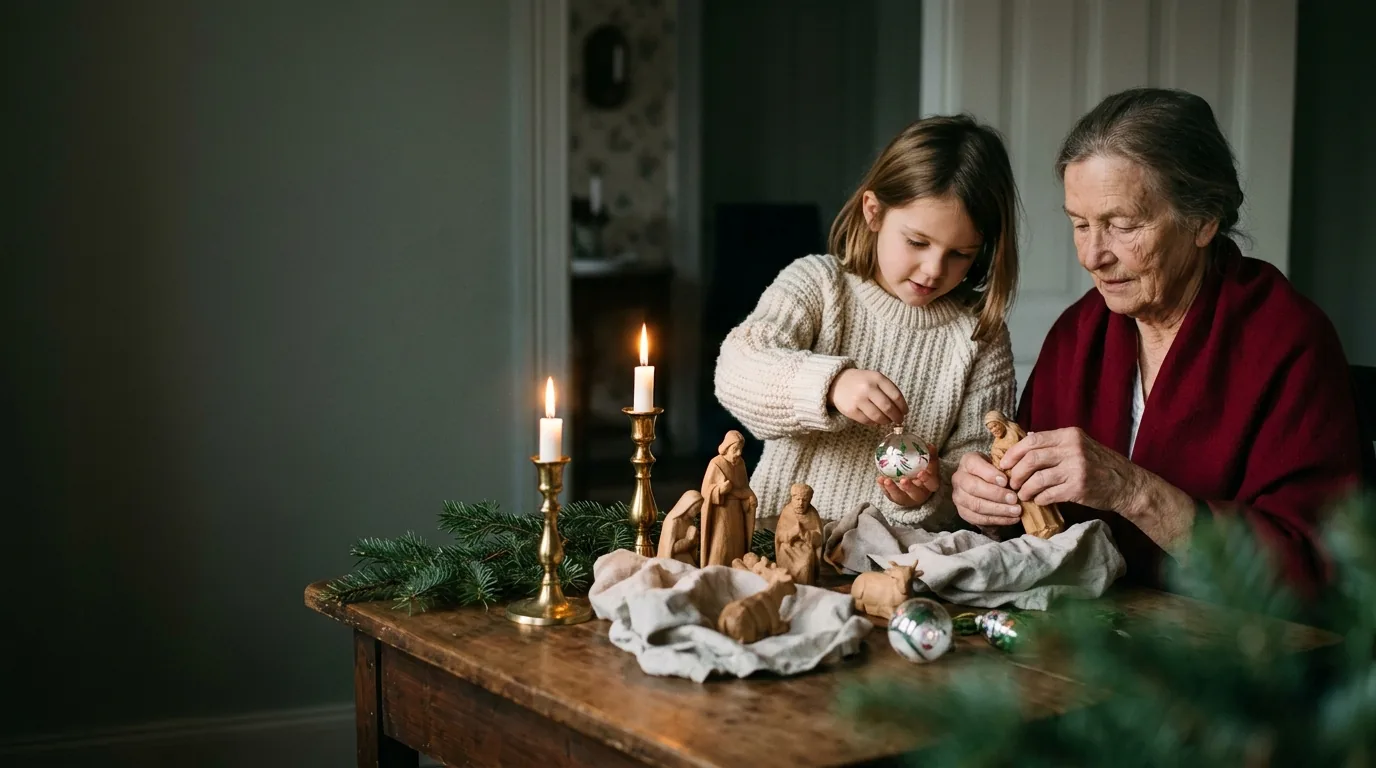
Nativity Scenes & Neapolitan Presepi
From 1223 Greccio and 1594 Jujuy to artisan Naples workshops
Literally meaning “feeding trough” from Latin praesaepe, the nativity scene blossomed after St. Francis of Assisi’s 1223 living crib in Greccio—reaching Argentina’s Quebrada de Humahuaca by 1594 under Father Gaspar de Monroy. Nowhere is the craft more theatrical than Naples, where Via San Gregorio Armeno artisans populate bustling eighteenth-century streetscapes around the Holy Family.
Traditions & Rituals45 BCE–present
New Year’s Day & New Year’s Eve (Año Nuevo y Año Viejo)
From Roman honey gifts to midnight toasts and effigies
Celebrated on January 1 since Julius Caesar’s calendar reform (45 BCE), New Year’s customs span ancient Roman strenae (gifts of honey, figs, and dates for a sweet year), Catholic observances of Mary, Mother of God, midnight family toasts, and Latin American Año Viejo effigies burned to bid farewell to the outgoing year.
Traditions & RitualsAndean Peru
Niños Adoradores (Peru)
Youth carolers and dancers visiting nativity scenes from Dec 25 to Jan 6
Across Andean Peru (and echoed in northwestern Argentina), groups of children known as Niños Adoradores go from house to house between December 25 and January 6 playing quena flutes, zampoñas, and rattles, singing villancicos and dancing before each family’s nativity scene in exchange for sweets, panetón, or small coins.
Traditions & Rituals18th c.–present
Novenas (Novena de Aguinaldos)
Nine days of prayer, carols, and family hospitality
In Catholic tradition, a novena spans nine days of devotion—echoing both the nine days of prayer between the Ascension and Pentecost and the Latin number novem (parallel to ancient Roman nine-day mourning observances). From December 16 to 24, families in Colombia, Ecuador, and Venezuela gather each evening around the pesebre for the Novena de Aguinaldos with villancicos, buñuelos, and natilla.
Characters & FiguresBasque Country & Navarre
Olentzero
Basque mountain charcoal burner who brings Christmas Eve gifts
Across the Basque Country and Navarre (including Pamplona and Bilbao), the jolly charcoal burner Olentzero—wearing a traditional txapela beret, rustic peasant clothes, and soot smudges—descends from the hills on December 24 in joyful parades to announce Christmas and deliver gifts to children, often accompanied by Mari Domingi.
Food & Drinks16th–20th century
Pan Dulce & Panettone
Milanese sweet bread embraced across Latin America
Documented in Lombardy by the late sixteenth century and celebrated in courtly Milanese legends (“pan del Toni”), Milan’s tall, airy panettone gained its paper-baked dome in the 1920s under bakers Angelo Motta and Gioacchino Alemagna. Carried across the Atlantic by Italian immigrants, pan dulce (or panetón) became indispensable on holiday tables from Argentina and Uruguay to Peru.
Texts & Beliefs1st century CE
Parable (Parábola)
Short symbolic teaching stories in the Gospels
From Greek parabolē (“comparison” or “placing side by side”), a parable is a concise, everyday story conveying a moral or spiritual lesson—memorably used in the New Testament Gospels in teachings such as the Lost Sheep (Luke 15 / Matthew 18), the Prodigal Son (Luke 15), and the Workers in the Vineyard.
Traditions & RitualsLate 19th c.–present
Parrandas Dominicanas & Los Guloyas
UNESCO-recognized Cocolo dance-drama and coastal Christmas street troupes
In San Pedro de Macorís, Dominican Republic, descendants of English-speaking Caribbean Cocolo migrants stage the vibrant Guloyas dance-drama beginning on Christmas Day (December 25), wearing feathered headdresses and mirrored costumes to enact folk plays like David and Goliath—a tradition recognized by UNESCO as Intangible Cultural Heritage. Elsewhere in Samaná and Sánchez, neighbors form festive street parrandas.
Texts & BeliefsLinguistic & Liturgical History
Pascua (Easter vs. Christmas Usage)
Why “Felices Pascuas” means Merry Christmas in Spanish-speaking regions
While Pascua strictly denotes Easter—commemorating Christ’s Resurrection in spring alongside symbolic Easter eggs and rabbits—Spanish speakers in Spain, Chile, and parts of Latin America also refer to the entire Nativity-to-Epiphany cycle as Pascuas (“Felices Pascuas” and Chilean “Pascua” / “Viejito Pascuero”), derived from Hebrew Pesach and Latin Pascha.
Traditions & Rituals16th century–present
Pastorelas
Humorous Mexican folk plays dramatizing the shepherds’ journey
Performed each December in parishes, plazas, and schools across Mexico and Central America, pastorelas grew out of sixteenth-century missionary theater into witty, allegorical plays where shepherds traveling toward Bethlehem outsmart comical devils tempting them along the road.
Music & CarolsDominican Republic
Perico Ripiao & Mañanitas (Dominican Republic)
Accordion, tambora, and güira serenades at holiday dawn
In the Dominican Republic, traditional three-to-four-piece perico ripiao ensembles—accordion, tambora drum, metal güira scraper, and vocals—bring fast-paced merengue típico to December plazas and early-morning mañanitas in towns such as Mao, where neighbors welcome musicians with steaming ginger tea (té de jengibre).
Traditions & Rituals16th century / Mexico
Piñata
Seven-pointed clay stars broken at Mexican posadas
Adapted in sixteenth-century New Spain—famously at the Augustinian convent of Acolman—from earlier Mesoamerican and Eurasian vessel traditions, the traditional Christmas piñata features a clay pot shaped into a colorful seven-pointed star. Blindfolded participants swing a stick to break it open, releasing seasonal fruits, peanuts, and candies.
History & SymbolsPre-Columbian Mexico–present
Poinsettia (Flor de Pascua / Nochebuena)
Mexico’s cuetlaxochitl known across continents as Estrella Federal
Native to southern Mexico and cultivated by the Aztecs as cuetlaxochitl long before 1828, Euphorbia pulcherrima turns its upper leaf bracts bright crimson each December. Known as flor de nochebuena in Mexico, flor de pascua in Spain and the Caribbean, and Estrella Federal in Argentina, it is the world’s iconic winter potted plant.
Food & DrinksColonial Mexico & Central America
Rompope (Rompopo)
Velvety spiced eggnog custard from Mexico and Central America
Developed in colonial convent kitchens of Puebla, Mexico, and cherished across Nicaragua and Central America (often called rompopo), rompope gently simmers egg yolks, milk, sugar, cinnamon, and vanilla, finished with rum and grated nutmeg for holiday toasts and desserts.
Characters & Figuresc. 343 / 1087
Saint Nicholas of Myra & Bari
Fourth-century bishop whose relics reached Bari in 1087
Born in Patara (Lycia, modern Turkey) and serving as fourth-century Greek Bishop of Myra (d. Dec 6, c. 343 CE), St. Nicholas became famed for secret generosity toward children, sailors, and the poor. In 1087 (not 1807), Italian sailors transferred his relics to Bari, inspiring December 6 gift customs and Dutch Sinterklaas.
Characters & Figures19th c.–present
Santa Claus, Papá Noel, Viejito Pascuero & Joulupukki
One global gift-bringer across languages and hemispheres
Known as Santa Claus (from Dutch Sinterklaas), Papá Noel across Argentina and Europe, Viejito Pascuero in Chile, and Joulupukki in Finland (with his Lapland home in Rovaniemi), the jolly gift-bringer blended St. Nicholas traditions with nineteenth-century New York literature (Irving, Moore) and Thomas Nast’s red-suited North Pole workshop.
Characters & Figures1823 / 1939
Santa’s Reindeer (Renos)
Eight Arctic flyers from 1823 poetry plus Rudolph in 1939
Native to Arctic tundra across Scandinavia, Siberia, and North America, reindeer entered Santa lore in Clement Clarke Moore’s 1823 poem “A Visit from St. Nicholas,” which introduced eight named reindeer—Dasher, Dancer, Prancer, Vixen, Comet, Cupid, Dunder (Donner), and Blixem (Blitzen). In 1939, copywriter Robert L. May added a ninth, red-nosed Rudolph.
Music & CarolsDecember 24, 1818
Silent Night (Noche de Paz)
Written by Joseph Mohr and Franz Xaver Gruber in 1818 Austria
First performed on Christmas Eve 1818 in Oberndorf near Salzburg, Austria, “Stille Nacht, heilige Nacht” pairs priest Joseph Mohr’s 1816 poem with schoolmaster Franz Xaver Gruber’s gentle melody for two voices and guitar. Recognized by UNESCO as intangible cultural heritage, the carol has been translated into more than 300 languages.
Texts & BeliefsAstronomical Debate
Star of Bethlehem (Estrella de Belén)
Astronomical theories from conjunctions to novae
Since Johannes Kepler in the 1600s, astronomers and historians have debated what celestial phenomenon could match the Gospel of Matthew’s Star of Bethlehem. In two landmark 1999 university-press studies, astronomer Michael R. Molnar (Rutgers) highlighted a lunar occultation of Jupiter in Aries on April 17, 6 BCE, while astrophysicist Mark Kidger (Princeton) proposed a 7 BCE Jupiter-Saturn triple conjunction followed by a 5 BCE nova.
Food & Drinks1329 / 1490 / Saxony
Stollen (Christstollen)
From 1329 Saxony fasting bread and 1490 Butterbrief to Dresden’s festive loaf
First documented in Naumburg, Saxony, in 1329, medieval Stollen began as an austere Advent fasting bread of flour, oats, and oil—shaped and dusted in white sugar to evoke the swaddled Christ Child. After Pope Innocent VIII’s 1490 Butterbrief lifted the butter ban, Dresden bakers turned Dresdner Christstollen into a rich delicacy of butter, raisins, candied citrus peel, and almonds.
Texts & BeliefsAntiquity–present
The Bible (La Biblia)
Gospel accounts of the Nativity and historic manuscripts
Composed of the Old Testament and 27 New Testament books (from Greek biblia, “books”), the Christian Bible includes the two canonical Nativity narratives in Matthew 1–2 and Luke 1–2. Historians also study ancient manuscripts such as the Dead Sea Scrolls of Qumran (discovered in 1947); today over five billion Bible copies have been distributed worldwide, with full or partial translations in more than 3,600 languages.
Characters & Figures1st–8th century–present
The Three Kings (Reyes Magos)
Biblical Magi, 6th–8th century names, and gift-bringing lore
The Gospel of Matthew describes Eastern magoi bringing gold, frankincense, and myrrh without specifying their number, royal rank, or names. Early Western tradition settled on three kings by the fifth century, while Caspar, Melchior, and Balthazar appeared in sixth-to-eighth-century sources (Ravenna mosaics, Excerpta Latina Barbari, Pseudo-Bede)—inspiring children across Spain and Latin America to leave shoes, water, and grass on January 5.
Traditions & RitualsCatalonia & Pyrenees
Tió de Nadal
Catalonia’s blanket-wrapped log that delivers sweets on Christmas Eve
In Catalonia, parts of Aragon, and Andorra, children care for the Tió de Nadal—a hollow log wearing a red barretina cap and warm blanket—feeding it fruit peels from December 8 onward. On Christmas Eve or Day, children tap the log with sticks while singing traditional songs until turrón and treats appear beneath its blanket.
Food & Drinks15th–16th c. / Spain
Turrón
Al-Andalus almond-and-honey nougat recorded in Alicante by 1582
Rooted in medieval Al-Andalus honey-and-almond confectionery, turrón was already famous in Alicante (crisp whole almonds) and Jijona (smooth stone-ground paste) in the fifteenth and sixteenth centuries—earlier than the seventeenth-century date sometimes cited. Municipal archives from 1582 even note Alicante officials receiving part of their Christmas pay in turrones.
Music & CarolsColombia
Tutaina (Tutaina Tuturumá)
Joyful Colombian villancico sung at Novenas de Aguinaldos
Sometimes misspelled “Tunaima” in older web archives, “Tutaina” (“Tutaina tuturuma, tutaina tuturumaina…”) is one of Colombia’s most beloved traditional villancicos. Its rhythmic, playful refrain gets families clapping and singing together around the pesebre throughout the nine nights of Novenas de Aguinaldos.
Traditions & Rituals1880s–1909 / Spain
Twelve Grapes (Las Doce Uvas)
Twelve midnight chimes for twelve lucky months
Documented in Madrid’s Puerta del Sol by the 1880s–1890s as popular satire of bourgeois grape-and-champagne parties and boosted nationwide after Alicante’s abundant 1909 harvest, eating one grape on each of the twelve midnight chimes on December 31 remains an iconic New Year’s Eve custom across Spain and Latin America.
Music & Carols15th century–present
Villancico
15th-century Iberian “villano” village songs turned Christmas carols
Named after Spanish villanos (inhabitants of rural villas or villages), the villancico emerged in fifteenth-century Spain and Portugal as a vernacular refrain-and-verse poetic form—polished by Renaissance masters like Juan del Encina—before Iberian and Latin American cathedrals made it the signature genre of Christmas music (rather than originating from an English court song under Henry I).
Characters & FiguresGarífuna Communities, Central America
Warini (Garífuna Christmas Herald)
Leaf-clad Central American dancer opening the festive season
Along the Caribbean coasts of Honduras, Guatemala, and Belize, Garífuna communities welcome Christmas with the Warini—a masked dancer clad in banana leaves, coconut fronds, and greenery accompanied by máscaro drummers and singers thanking the community for the year’s harvest, part of UNESCO-recognized Garífuna heritage.