10th–13th c.
Earliest Iberian Latin and vernacular musical manuscripts of the Sibyl prophecy.
A medieval Christmas Eve liturgical drama preserved for centuries in Mallorca and recognized by UNESCO.
Earliest Iberian Latin and vernacular musical manuscripts of the Sibyl prophecy.
Sung a cappella with a raised sword and organ interludes before Midnight Mass.
Inscribed as Intangible Cultural Heritage of Humanity in Mallorca.
El Canto de la Sibila (Catalan: El Cant de la Sibil·la) is a medieval solo liturgical chant performed on Christmas Eve (December 24) before Midnight Mass. Dating back to early Christian Latin acrostics and vernacular Iberian melodies of the tenth to thirteenth centuries, it survives continuously in Mallorca and Alghero and was inscribed by UNESCO in 2010.
The chant derives from a Greek and Latin acrostic poem—Judicii signum (The Sign of Judgment)—attributed in late antiquity to the Erythraean Sibyl and cited by St. Augustine in The City of God. Christian tradition interpreted the Sibyl as a pagan prophetess who foretold both the birth of Christ and the Last Judgment.
From the tenth century onward, monasteries and cathedrals across Catalonia, Valencia, Castile, southern France, and Italy set the prophecy to solemn Gregorian-style melodies, translating the Latin verses into Catalan, Occitan, and Castilian.
In the sixteenth century, the liturgical reforms of the Council of Trent suppressed most vernacular paraliturgical dramas across Catholic Europe, and the Song of the Sibyl gradually disappeared from mainland cathedrals.
Remarkably, the parishes of Mallorca (Balearic Islands, Spain) and the Catalan-speaking city of Alghero (Sardinia, Italy) kept the chant alive without interruption every Christmas Eve, passing the melody and staging down across generations.
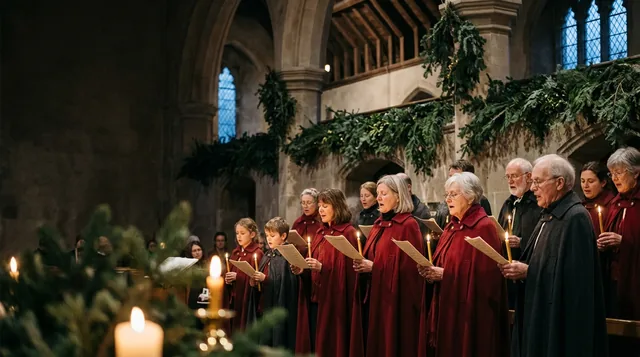
During Matines (Midnight Mass vigil) on December 24, a solo boy soprano or woman dressed in an embroidered silk tunic, cape, and headdress walks slowly toward the altar holding a raised double-edged sword upright before her face—a traditional emblem of justice and solemn awe.
Each unaccompanied vocal stanza ends with a haunting refrain, punctuated between verses by brief meditative interludes on the church organ.
In November 2010, UNESCO inscribed the Chant of the Sybil on Majorca on the Representative List of the Intangible Cultural Heritage of Humanity.
Alongside its unbroken celebration in Mallorca’s cathedral and village churches, early-music ensembles and cathedrals in Toledo, Valencia, Barcelona, and Girona have revived historical versions of the chant during Advent and Christmas Eve.
From fourth-century Roman calendars and medieval folk carols to nineteenth-century family customs.
From Advent and St. Nicholas Day to Nochebuena, Boxing Day, Epiphany, and Candlemas.
How St. Francis of Assisi’s 1223 Greccio gathering inspired centuries of nativity craftsmanship.